Access the essential membership for Modern Managers
Key Takeaways:
- "Locus of control" reflects the degree to which people believe outcomes are shaped by their own actions or external forces.
- Internal locus of control is a belief in controlling our own destiny. It's associated with hard work and perseverance but can lead to frustration or anxiety.
- External locus of control is a belief that outcomes are influenced by luck, fate, or authority figures. It can lead to pessimism or giving up, but may reduce stress over uncontrollable events.
- Take this self-assessment to understand your natural tendency and then learn to adapt your perspective to suit different situations.
As the environment around you changes, you can either attribute success and failure to things you have control over, or to forces outside your influence.
Which orientation you choose has a bearing on your long-term success.
This orientation is known as your "locus of control." Its study dates back to the 1960s, with Julian Rotter's investigation into how people's behaviors and attitudes affected the outcomes of their lives.
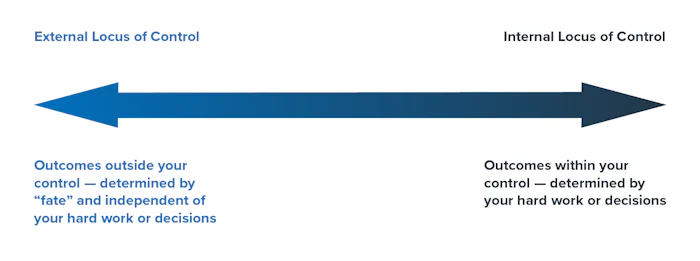
Locus of control describes the degree to which individuals perceive that outcomes result from their own behaviors, or from forces that are external to themselves. This produces a continuum with external control at one end and internal control at the other, as shown in figure 1, below:
People who develop an internal locus of control believe that they are responsible for their own success. Those with an external locus of control believe that external forces, like luck, determine their outcomes.
Use the interactive quiz below to determine your current locus of control:
Locus of Control Test
Instructions:
For each pair of statements, choose the one that you believe to be the most accurate, not the one you wish was most true. Remember, there are no right or wrong answers. Click the "Calculate My Total" button to add up your score and check your result using the scoring table underneath.
Note:
This assessment has not been validated and is intended for illustrative purposes only. It is patterned after the Locus of Control Scale developed and presented in Rotter, J.B. (1966), "Generalized expectancies for internal versus external control of reinforcement," Psychological Monographs, 80 (Whole No. 609).
Locus of Control: Types and Examples
Internal Locus of Control (strong)
If you have a strong internal locus of control, you will likely feel that you’re in full control of the events in your life. You are self-motivated and focused on achieving the goals you have set for yourself. For these reasons, people with a strong internal locus of control often make good leaders.
However, there is a potential downside to having a very strong internal locus of control. Your powerful self-belief may mean that you find it difficult to take direction, so be careful to avoid seeming arrogant or "walking over" other people in pursuit of your objectives. And be sure to manage risks properly – random events do occur for all sorts of reasons.
A very strong internal drive may lead you to believe that you can control everything, and if your plans don’t work out you may feel responsible for their failure – even when events were genuinely beyond your control. This can lead to frustration, anxiety and, in extreme cases, stress or depression.
Internal Locus of Control (moderate)
You likely see your future as being in your own hands. As a result, you engage in activities that will improve your situation: you work hard to develop your knowledge, skills and abilities, and you take note of information that you can use to create positive outcomes.
However, few people have a wholly internal or external locus of control: most of us fall somewhere between the two ends of the spectrum. Your locus of control may vary in different situations – at work and at home, for example – and it may change over time. People often tend toward a more internal locus of control as they grow older and their ability to influence the events in their lives increases.
Having a moderate, rather than strong, internal locus of control may make you more able to accept situations that you can’t influence, and to manage them effectively when they arise.
External Locus of Control
If you have an external locus of control, you likely believe that what happens to you is the result of luck or fate, or is determined by people in authority. You may tend to give up when life doesn't "go your way," because you don’t feel that you have the power to change it.
To overcome this, pay attention to your self-talk. When you hear yourself saying things like "I have no choice," or "There's nothing I can do," step back and remind yourself that you can always make choices. Set goals for yourself and note how you are making positive changes in your life by working toward and achieving these goals. You'll find that your self-confidence quickly builds.
You may find it useful to develop your decision making and problem-solving skills. These tools can enable you to take greater ownership of situations, rather than blaming circumstances or forces "beyond your control" when things go wrong.
Tip:
To learn more about your locus of control, and how to change it, read our article, Understanding Your Locus of Control.
Frequently Asked Questions about Locus of Control
1. What is locus of control?
"Locus of Control" refers to how strongly people believe they have control over the situations and experiences that affect their lives. It is typically categorized into two types:
- Internal locus of control. People believe that their own actions, decisions and efforts directly influence the things that happen to them.
- External locus of control. Individuals feel that external factors, such as luck, fate, or other people, have a greater influence on their life outcomes.
2. How does locus of control impact behavior and decision making?
Locus of control significantly impacts behavior and decision making by influencing how people perceive their ability to control their experiences.
Those with an internal locus of control are more likely to take initiative, set goals, and persist through challenges, believing that their efforts can lead to desired outcomes.
But those with an external locus of control may feel less motivated to take action or make changes, attributing success or failure to factors beyond their control.
3. Can locus of control be changed?
Yes. It can be changed through cognitive-behavioral techniques and personal-development strategies. Steps to move toward a more internal locus of control include:
- Self-reflection: identifying and challenging beliefs about control and responsibility.
- Goal setting: establishing clear, achievable goals and developing plans to reach them.
- Skill development: building competencies and gaining knowledge to increase confidence in your abilities.
- Positive reinforcement: recognizing and rewarding personal effort and success.
- Resilience training: learning to cope with setbacks, and viewing them as opportunities for growth.
In these ways, it's possible to develop a stronger sense of control over your experience.
Key Points
Your locus of control says a lot about how you view the world and your role in determining the course of your life.
When you believe you have the power to control your own destiny and determine your own direction, you have a strong internal locus of control. In most cases, this is an important attitude to have if you want to be successful.
People with an internal locus of control tend to work harder and persevere longer in order to get what they want. This is not to say that having an external locus of control is always bad: there are some situations where this approach can work well. The key for your own personal development is to understand your natural tendency and then adapt it to the situations you're faced with.
ReferencesRotter, J.B. (1966), "Generalized expectancies for internal versus external control of reinforcement," Psychological Monographs, 80 (Whole No. 609).[online]. (Available
here.) [Accessed October 15, 2019.]