Access the essential membership for Modern Managers
What is the first thing that pops in your mind when you hear the term corporate culture? A great many people refer to the classic phrase coined by the McKinsey organization, that culture is "how we do things around here." And while that may be true, there are so many elements that go into determining what you do and why, that this definition only scratches the surface.
Whether you can define it or not, you know that culture exists. It's that ethereal something that hangs in the air and influences how work gets done, critically affects project success or failure, says who fits in and who doesn't, and determines the overall mood of the company.
Culture often becomes the focus of attention during periods of organizational change – when companies merge and their cultures clash, for example, or when growth and other strategic change mean that the existing culture becomes inappropriate, and hinders rather than supports progress. In more static environments, cultural issues may be responsible for low morale, absenteeism or high staff turnover, with all of the adverse effects those can have on productivity.
So, for all its elusiveness, corporate culture can have a huge impact on an organization's work environment and output. This is why so much research has been done to pinpoint exactly what makes an effective corporate culture, and how to go about changing a culture that isn't working.
Fortunately, while corporate culture can be elusive, approaches have been developed to help us look at it. Such approaches can play a key role in formulating strategy or planning change.
The Cultural Web, developed by Gerry Johnson and Kevan Scholes in 1992, provides one such approach for looking at and changing your organization's culture. Using it, you can expose cultural assumptions and practices, and set to work aligning organizational elements with one another, and with your strategy.
Elements of the Cultural Web
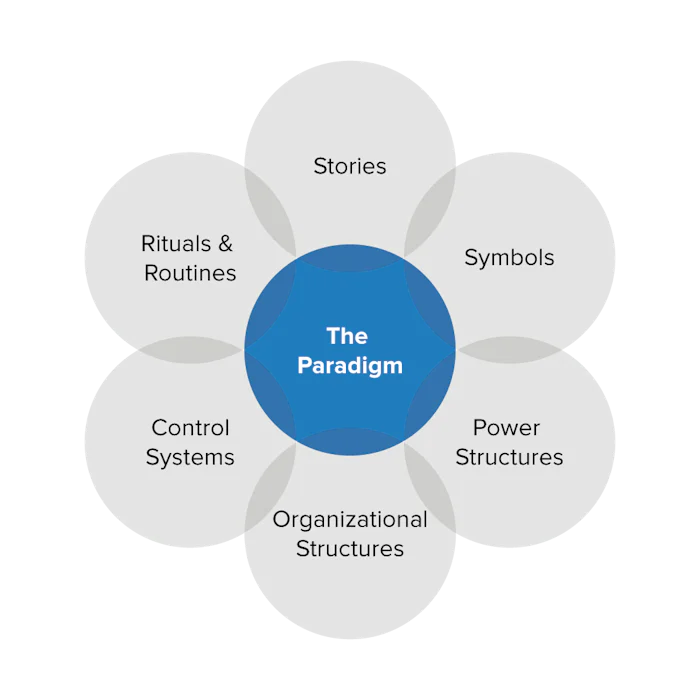
The Cultural Web identifies six interrelated elements that help to make up what Johnson and Scholes call the "paradigm" – the pattern or model – of the work environment. By analyzing the factors in each, you can begin to see the bigger picture of your culture: what is working, what isn't working, and what needs to be changed. The six elements are:
- Stories – The past events and people talked about inside and outside the company. Who and what the company chooses to immortalize says a great deal about what it values, and perceives as great behavior.
- Rituals and Routines – The daily behavior and actions of people that signal acceptable behavior. This determines what is expected to happen in given situations, and what is valued by management.
- Symbols – The visual representations of the company including logos, how plush the offices are, and the formal or informal dress codes.
- Organizational Structure – This includes both the structure defined by the organization chart, and the unwritten lines of power and influence that indicate whose contributions are most valued.
- Control Systems – The ways that the organization is controlled. These include financial systems, quality systems, and rewards (including the way they are measured and distributed within the organization).
- Power Structures – The pockets of real power in the company. This may involve one or two key senior executives, a whole group of executives, or even a department. The key is that these people have the greatest amount of influence on decisions, operations, and strategic direction.
From "Fundamentals of Strategy" by G. Johnson, R. Whittington, and K. Scholes. Published by Pearson Education, 2012. Reproduced with permission.
These elements are represented graphically as six semi-overlapping circles (see figure 1 below), which together influence the cultural paradigm.
From "Fundamentals of Strategy." Reproduced with permission.
Using the Cultural Web
We use the Cultural Web firstly to look at organizational culture as it is now, secondly to look at how we want the culture to be, and thirdly to identify the differences between the two. These differences are the changes we need to make to achieve the high-performance culture that we want.
1. Analyzing Culture as It Is Now
Start by looking at each element separately, and asking yourself questions that help you determine the dominant factors in each element. Elements and related questions are shown below, illustrated with the example of a bodywork repair company.
Stories
- What stories do people currently tell about your organization?
- What reputation is communicated amongst your customers and other stakeholders?
- What do these stories say about what your organization believes in?
- What do employees talk about when they think of the history of the company?
- What stories do they tell new people who join the company?
- What heroes, villains and mavericks appear in these stories?
Examples (car bodywork repair company):
- We are known as having high customer complaints, and for doing shoddy work.
- Staff members talk about the founder starting the company with a $1,000 loan.
- The message is that we do things the cheapest way we can.
Rituals and Routines
- What do customers expect when they walk in?
- What do employees expect?
- What would be immediately obvious if changed?
- What behavior do these routines encourage?
- When a new problem is encountered, what rules do people apply when they solve it?
- What core beliefs do these rituals reflect?
Examples:
- Customers expect a newspaper and coffee whilst they wait, or a ride to work.
- Employees expect to have their time cards examined very carefully.
- There's lots of talk about money, and especially about how to cut costs.
Symbols
- Is company-specific jargon or language used? How well known and usable by all is this?
- Are there any status symbols used?
- What image is associated with your organization, looking at this from the separate viewpoints of clients and staff?
Examples:
- We use bright red shuttle vans.
- We offer bright red courtesy cars – compact, economy cars.
- The boss wears overalls, not a suit.
Organizational Structure
- Is the structure flat or hierarchical? Formal or informal? Organic or mechanistic?
- Where are the formal lines of authority?
- Are there informal lines?
Examples:
- Flat structure – Owner, Head Mechanic, Mechanics, Reception.
- The receptionist is the owner's wife so she goes straight to him with some customer complaints.
- It's each mechanic for himself – no sharing tools or supplies, little teamwork.
Control Systems
- What process or procedure has the strongest controls? Weakest controls?
- Is the company generally loosely or tightly controlled?
- Do employees get rewarded for good work or penalized for poor work?
- What reports are issued to keep control of operations, finance, etc...?
Examples:
- Costs are highly controlled, and customers are billed for parts down to the last screw.
- Quality is not emphasized. Getting the work done with the least amount of direct costs is the goal.
- Employees docked pay if their quotes/estimates are more than 10% out.
Power Structures
- Who has the real power in the organization?
- What do these people believe and champion within the organization?
- Who makes or influences decisions?
- How is this power used or abused?
Example:
- The owner believes in a low cost, high-profit model, and is prepared to lose repeat customers.
- The threat of docked pay keeps mechanics working with this model.
As these questions are answered, you start to build up a picture of what is influencing your corporate culture. Now you need to look at the web as a whole and make some generalized statements regarding the overall culture.
These statements about your corporate culture should:
- Describe the culture.
- Identify the factors that are prevalent throughout the web.
In our example, the common theme is tight cost control at the expense of quality, and at the expense of customer and employee satisfaction.
2. Analyzing Culture as You Want It to Be
With the picture of your current cultural web complete, now's the time to repeat the process, thinking about the culture that you want.
Starting from your organization's strategy, think about how you want the organization's culture to look, if everything were to be correctly aligned, and if you were to have the ideal corporate culture.
3. Mapping the Differences Between the Two
Now compare your two Cultural Web diagrams, and identify the differences between the two. Considering the organization's strategic aims and objectives:
- What cultural strengths have been highlighted by your analysis of the current culture?
- What factors are hindering your strategy or are misaligned with one another?
- What factors are detrimental to the health and productivity of your workplace?
- What factors will you encourage and reinforce?
- Which factors do you need to change?
- What new beliefs and behaviors do you need to promote?
4. Prioritize Changes, and Develop a Plan to Address Them
Key Points
Used in this way, Johnson and Scholes' Cultural Web helps you analyze your current culture, and identify what needs to stay, go or be added to if you're to achieve your strategic goals.
Implementing cultural changes is not simple: it involves re-molding values, beliefs and behavior, and it's a major change management challenge, taking a great deal of time and hard work from everyone involved. By providing a framework for analyzing the current culture, and designing changes, Johnson and Scholes' Cultural Web provides a good foundation for the difficult business of changing organizational culture. Using it, you can create a cultural environment that encourages success, supports the organization's objectives and, all-in-all, makes for a better place to work.