Access the essential membership for Modern Managers
Key Takeaways:
- The Three Horizons of Growth model outlines the three types of innovation that businesses need for sustained success.
- Horizon 1 relates to your organization’s current money-making products and services.
- Horizon 2 focuses on emerging businesses, often expanding on existing products.
- Horizon 3 refers to ideas for future ventures or revenue streams and covers a wide variety of opportunities.
- Businesses must explore all three horizons simultaneously to ensure short-, medium- and long-term profitability, particularly in today’s changeable climate.
- Embracing new technologies and agile ways of working are essential to responding quickly to market disruptions and emerging trends.
There are two types of businesses: those that are born, mature and then – seemingly inevitably – fade away. And those that avoid the downturn entirely; they sustain their growth over decades and continue to surprise customers with their innovation and creativity.
As a CEO or senior leader, it’s your responsibility to help your organization to go from strength to strength. Those who do this best devote time, energy and resources into developing new ideas that mature and become profitable, replacing older products and businesses as they fall away.
In this article, we’ll look at how you can use McKinsey’s Three Horizons of Growth to focus your efforts on projects that sustain your organization in the long-term.
What Is McKinsey's Three Horizons of Growth Model?
Mehrdad Baghai, Stephen Coley and David White, partners at McKinsey & Company, published the Three Horizons of Growth model in their 2000 book, "The Alchemy of Growth."
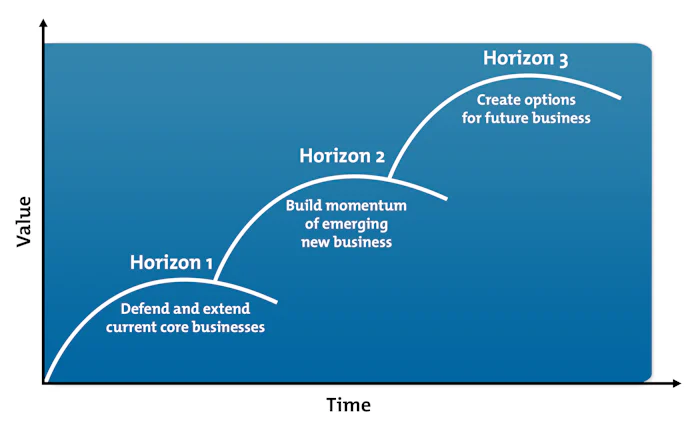
The model, shown in Figure 1 below, outlines three different types of innovation that need to go on in parallel for a business to be successful. Organizations must invest in each one, and meet the specific management challenges that accompany them, to sustain long-term growth.
The framework prioritizes developing future revenue streams and business opportunities, so that, when existing products have run their course, new ones are ready to take their place.
Figure 1: The Three Horizons of Growth
The three phases are:
- Horizon 1: this refers to your organization's current core businesses – the products and brands generating the most profit right now.
- Horizon 2: this relates to your organization's emerging businesses or products. These are still in their early stages, and require investment or research to thrive. However, they generate plenty of interest among your investors and customers.
- Horizon 3: this focuses on your organization's seedling investments, and ideas for future business. These could be research projects, early discussions or alliances, or products still being prototyped.
Benefits and Uses of the Three Horizons Model
The Three Horizons of Growth model sets your business up for success in the short-, medium- and long-term. But only if you explore all three horizons simultaneously.
Businesses need ongoing innovation at every horizon, not only to sustain growth but also to remain competitive. Those that don’t continuously improve risk becoming obsolete.
For example, some organizations focus entirely on Horizon 1 products. As these fall away, there are no other opportunities waiting to replace them. Others may linger too long on horizons 2 and 3. But without the revenue from existing products, they fail to raise the funds for future ventures.
McKinsey’s model isn’t limited to product development. It can also be a useful guide when expanding your business or developing a long-term recruitment plan.
For example, you might have a strong local brand in Horizon 1 that you plan to turn into an international operation in Horizons 2 and 3, with modified or entirely new products.
Or you may wish to grow your team to include entrepreneurial professionals skilled at building new businesses in Horizon 2. Meanwhile, Horizon 3 recruitment could target researchers, visionaries or even rebels, who think outside the box and bring new ideas to the table.
Pitfalls of the Three Horizons Model
While McKinsey’s model still earns its spot as one of the most effective frameworks for growing businesses, some argue that the model has become less relevant in today’s changeable climate. [1]
Originally, the Three Horizons model associated each horizon with specific timeframes:
- Horizon 1: Immediate to short-term (0-3 years)
- Horizon 2: Medium-term (3-7 years)
- Horizon 3: Long-term (7+ years)
However, these timeframes have become less rigid as rapid technological advancements and globalization have accelerated business cycles.
Innovations that once took years to develop can now be realized much faster. Competitors may utilize technology and techniques from Horizon 1 to act quickly, meaning that market disruptions can arise seemingly overnight.
As a result, the boundaries between the horizons have blurred and businesses need to be able to respond quickly to changes in the market. But McKinsey’s model is far from defunct. In fact, it’s more important than ever to assess all three horizons at once.
How to Use the Three Horizons in Your Organization
Let’s explore the strategies you can use as a CEO or senior leader to apply McKinsey’s Three Horizons model in the contemporary business landscape:
Applying Horizon 1
Horizon 1 represents your core businesses: the brands, products or services that customers associate with your company right now.
Profitability is extremely important: your financial performance in Horizon 1 will directly impact what you can achieve in Horizons 2 and 3. So, consider how you can protect, enhance and streamline your products for optimal profit and growth.
Use tools like SWOT and USP Analysisto identify your business’s strengths and weaknesses, and how you can improve your position in the market. Data analytics and market segmentation can help you to evaluate the success of your current products and identify new opportunities for growth.
Applying Horizon 2
Now it's time to look at what your organization invests in. Often, Horizon 2 businesses are a natural expansion of the products and services that you already offer in Horizon 1.
Ask yourself, have you invested in viable businesses that have the potential to replace your current moneymakers? Are you gaining momentum in your respective markets? And if not, how can you enhance existing successful products for the future?
Consider potential competitors or changes that could threaten or benefit your business. For example, developments in A.I. may endanger your existing offering. But they could also create opportunities for new products that set you apart from the competition.
Use Agile methods to test and scale these new ideas more quickly across all horizons. This is especially relevant for Horizons 2 and 3, where early feedback loops and rapid prototyping can speed up the development of emerging products.
Applying Horizon 3
Your last step is to look at ideas and growth opportunities that might be years away from production or profitability. These might be nothing more than rough plans or research projects that are underway.
Regardless, set time and resources aside to brainstorm ideas and encourage your people to "think big" about what you could achieve. With hybrid and remote work now common, consider the digital collaboration tools and communication strategies that decentralized teams may need to use to work creatively.
Now look at the variety of ideas and projects in the pipeline. Do you have several options, or are they all focused in one area? If the scope is too narrow, look at how you can widen it. Your goal is to have a rich source of potential products and businesses that fit with your organization's business model and can be adapted according to changes in the market.
The contemporary business landscape values partnerships for access to technology, markets, or expertise. Now is the time to seek partnerships for Horizon 3 projects and beyond to leverage complementary strengths.
Last, it's not enough to have good ideas; you need to be able to develop the best ones, so that they can make the transition into Horizon 2. Data analytics are crucial to identify and pursue your best prospects.
Frequently Asked Questions
The Three Horizons of Growth model outlines the three types of innovation that businesses need for sustained success.
- Horizon 1 relates to your organization’s current money-making products and services.
- Horizon 2 focuses on emerging businesses, often expanding on existing products.
- Horizon 3 refers to ideas for future ventures or revenue streams, and covers a wide variety of opportunities.
The model was developed by McKinsey partners Mehrdad Baghai, Stephen Coley and David White in their 2000 book, “The Alchemy of Growth.”
Rapid technological advancements and globalization mean that businesses emerge and decline quicker than ever before.
As a result, business cycles are shorter and less predictable than when the Three Horizons model was first created.
This shift suggests that organizations need to be agile and prepared to address opportunities and threats across all horizons simultaneously.
While it is predominantly used to discuss continuous product development, CEOs and senior leaders can also use the Three Horizons model when developing recruitment or expansion plans.
For example, you may choose to hire different people for different horizons, such as creatives for long-term, horizon 3 development. Or you may schedule expanding into new territories or markets according to your horizons.
References[1] Crouch, R. (2020) ‘McKinsey’s Three Horizons Model Defined Innovation for Years. Here’s Why It No Longer Applies.’ August 2020. (Available
here.)