

Key Takeaways:
- AI can have a huge positive effect on your team’s productivity.
- Start with a focused audit of your team's activities into four categories: routine/repetitive, strategic/creative, relationship-based, and decision-making tasks.
- Ensure that you focus initially on well-documented, repetitive, low-risk processes.
- Use AI for initial research and briefing work, and data processing.
- Set up regular team discussions about AI implementation and analyze specific metrics, like time saved and team satisfaction.
- Remember to use human judgment for editing and final decision-making.
The numbers paint a striking picture: in one study, 96 percent of C-suite leaders expected AI to boost productivity, while 77 percent of employees reported that it was actually increasing their workload. [1]
The truth is, AI can dramatically boost team performance – MIT researchers found it can improve worker productivity by up to 40 percent when used correctly. [2] But that crucial phrase "when used correctly" is where many teams stumble.
This article will show managers how to help their team harness AI's potential while avoiding common pitfalls. Read on to discover practical steps for integration, clear guidelines for appropriate AI tasks, and real-world success stories.
How Can AI Boost Productivity?
Research by consultants McKinsey shows that current AI technologies could automate 60-70 percent of the time employees spend working today. [3]
Access the essential membership for Modern Managers
But what does this mean for your team in practical terms? Let's break down how AI boosts teams’ productivity.
- Smarter data processing. AI can analyze vast amounts of data in seconds, spotting patterns humans might miss. For example, AI can scan thousands of customer service interactions to identify common issues and solutions.
- Automating routine work. AI excels at automating repetitive tasks like data gathering, report generation and routine documentation. This automation frees your team to focus on work that requires human insight and creativity.
- Enhancing decision-making. Rather than manually reviewing datasets, teams can analyze the results in seconds before using their judgment to make data-driven decisions.
- Redistributing teams’ time. By using AI to automate routine tasks, teams can invest their time in higher-value activities. For example, strategic planning, creative problem-solving, team development, or developing customer relationships.
How to Integrate AI Into Your Team
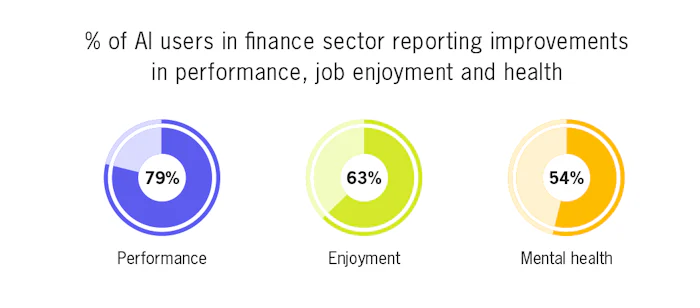
Figure 1: Percentage of AI users surveyed in the finance sector who reported improvements in performance, job enjoyment and mental health. Source: OECD [4]
The benefits of using AI are real. Figure 1 shows the improvements to finance sector workers’ experiences when using it. Before rushing to implement AI tools, take a step back and consider your strategy.
Using AI for a task outside its capabilities decreases worker’s performance by 19 percent. [2] For example, tasks which include decision-making based on qualitative evidence are not a good fit for AI. So, managers must be highly selective about which tasks to tackle using it.
Access the essential membership for Modern Managers
Here's how to get started.
Step 1: Audit your current workflows
- Create a simple audit of your team's activities, categorizing them using the following criteria:
- Routine and repetitive
- Strategic and creative
- Relationship-based
- Decision-making intensive
Step 2: Choose your starting point
Select one process that your team can test using AI to carry out. This task should be well documented, repetitive, time-consuming, and low-risk.
Step 3: Involve your team
When teams help shape implementation, they're more invested in making it work. Create regular opportunities for team members to test tools, share concerns, and contribute ideas.
Access the essential membership for Modern Managers
Step 4: Establish clear boundaries
Having done the initial audit and test to decide where AI fits in your workflows, decide what tasks it is best suited to. Work with your team to create a list of tasks that AI should and shouldn’t be used for.
Step 5: Monitor and adjust
Set up regular check-ins to measure time savings, assess quality improvements, gather team feedback, and fine-tune processes.
The Four Building Blocks of AI Readiness
Before implementing specific AI tools, managers need to ensure their team has the right foundations in place. Understanding and establishing these four building blocks, identified by MIT Sloan Management School research, helps create an environment where AI integration can thrive while maintaining team engagement and effectiveness. [2]
- Accountability. Establish clear ownership of AI initiatives and specific metrics to measure progress.
- Peer coaching. Create structured peer coaching systems for team members to share knowledge and best practices.
- A collaborative approach. Design clear workflows that optimize how humans and AI work together.
- Role flexibility. Allow team members’ roles to evolve over time as AI capabilities grow.
Access the essential membership for Modern Managers
What Challenges Do Teams Encounter When Using AI?
While AI can significantly boost productivity, there are several key challenges that teams must actively manage to succeed. These are shown in Table 1.
Table 1. The Challenges, Impacts and Solutions of using AI
Challenge
Impact
Solution
Access the essential membership for Modern Managers
Over-reliance on AI
Teams accept AI outputs without question, leading to mistakes.
Establish clear review protocols and use humans to review AI-generated work.
Data privacy concerns
Unclear guidelines about AI data usage lead to either overly cautious usage or security risks, impacting productivity.
Create a clear framework for what information can and can’t be processed through AI tools.
Access the essential membership for Modern Managers
Uneven adoption
Some team members race ahead while others resist, creating productivity gaps and workflow inconsistencies.
Implement structured peer learning programs and set clear expectations for minimum AI tool usage. Celebrate both early adopters and steady progress.
Integration confusion
Teams waste time figuring out when to use AI versus using traditional methods.
Develop a clear task classification system specifying which activities should use AI and which should remain manual. Make guidance easily accessible.
Access the essential membership for Modern Managers
Quality inconsistency
Teams struggle to maintain consistent output quality when using AI tools, leading to extra review time.
Create standardized prompts and templates for common AI tasks. Establish quality benchmarks and regular review processes.
AI Success Stories
Access the essential membership for Modern Managers
Here are two real-world examples that demonstrate the power of effective AI implementation.
- A Fortune 500 software company equipped 5,000 customer support agents with AI-powered conversational scripts. [5] The results showed a 14 percent boost in productivity (measured by issues resolved per hour). The impact was even more significant for newer team members, who saw 35 percent faster resolution times.
- Mastercard used AI to transform its fraud detection capabilities. [6] In 2024 it reported that its AI system doubled the speed of identifying compromised cards while reducing false positives (a test result which wrongly indicates that fraud has occurred, when it hasn’t) by 200 percent. Most impressively, the system increased the speed of identifying at-risk merchants by 300 percent.
Frequently Asked Questions
1. How can managers determine which tasks to assign to AI?
Start with repetitive, well-documented, low-risk tasks like data processing or routine reporting, and avoid complex or poorly defined processes.
2. What are the main benefits of using AI in team workflows?
AI automates repetitive tasks, processes data efficiently, improves decision-making, and allows teams to focus on creative and strategic work.
Access the essential membership for Modern Managers
3. How should teams address concerns about over-reliance on AI?
Establish clear review protocols ensuring human oversight of AI outputs, particularly for final decisions and quality assurance.
4. What is the best way to measure the success of AI implementation?
Track metrics like time saved, quality of output, team satisfaction, and overall impact on key performance indicators (KPIs).
5. How can managers encourage team adoption of AI tools?
Involve teams in implementation, provide structured peer coaching, set clear expectations, and celebrate progress to address resistance.
Let’s Act
Access the essential membership for Modern Managers
Start driving your team’s productivity with AI right now.
- Choose one task which you think could be carried out using AI. Check that it satisfies the criteria in this article.
- Establish the length of time the task would normally take.
- Assign it to a team member. And ask them to use a suitable AI tool to perform the task.
- On completion, review the time taken and the quality of the output with your team. Then decide on your next steps (for example, proceed to rollout AI for the task, or refine the process further).
- Upwork (2024), Upwork study finds employee workloads rising despite increased collaboration. Available here (Accessed: 8 November 2024).
- MIT Sloan (2024) How generative AI can boost highly skilled workers’ productivity. Available here. (Accessed: 8 November 2024).
- McKinsey & Company (2023) The economic potential of generative AI: The next productivity frontier. Available here. (Accessed: 8 November 2024).
- Filippucci, F., Gal, P., Jona-Lasinio, C., Leandro, A. and Nicoletti, G. (2024) The impact of Artificial Intelligence on productivity, distribution and growth: Key mechanisms, initial evidence and policy challenges. OECD Artificial Intelligence Papers, April 2024. Available here. (Accessed: 8 November 2024).
- Brynjolfsson, E.Li, D. and Raymond, L. (2023) "Generative AI at Work," NBER Working Papers 31161, National Bureau of Economic Research, Inc. Available here. (Accessed: 8 November 2024).
- Mastercard (2024) Mastercard accelerates card fraud detection with generative AI technology. Available here. (Accessed: 8 November 2024).
Share this post
Discover more content

How to Spot Real and Fake News
Fake news can destroy trust, damage learning culture, and sap curiosity. Make sure you know how to tell fact from fiction using these six steps.

Using Quantitative and Qualitative Data
An outline of some methods for gathering and using quantitative data.

A Guide to Data Protection
The European General Data Protection Regulation (GDPR) sets out rules for all organizations that keep or process personal information on individuals. Here's an overview.