Access the essential membership for Modern Managers
In many organizations, it's hard to remember a time when non-managerial employees were kept in the dark about strategy.
We're often reminded about the corporate mission statement, we have strategy meetings where the "big picture" is revealed to us, and we're even invited to participate in some business decisions. We're also kept aware of how our day-to-day activities contribute to corporate goals.
But this type of managing hasn't been around forever. It's an approach called Management by Objectives (MBO), a system that seeks to align employees' objectives with the organization's goals. In this article, we'll look at how you can use MBO to motivate and engage your team.
About the Tool
Peter Drucker developed MBO, and published it in his 1954 book, "The Practice of Management." [1] It received a great deal of attention, and it was widely adopted until the 1990s, when it seemed to fade into obscurity.
The idea may have become a victim of its own success; it became such an integral part of modern business practice that it may no longer have seemed worthy of comment.
Advantages and Disadvantages
But using Management by Objectives with your team offers several benefits.
First, MBO ensures that team members are clear about their work and how it benefits the whole organization. It's easy to see why this type of managing makes sense: when the individual parts of an organization work well together, the whole operates smoothly and efficiently. By focusing on what you're trying to achieve, you can quickly distinguish between tasks that you must complete, and those that may not be worth your time.
Implemented on a team level, MBO can be seen in many of the key techniques needed for effective team management, including team briefing, goal setting, performance appraisal, delegation, and feedback.
On an individual level, we all want to see our work as purposeful and meaningful, and MBO makes a clear link between individual effort and the organization's mission – this is great for our sense of purpose!
One disadvantage of MBO is that it can be challenging and lengthy to implement. When applied on an organizational level, MBO needs the organization's full commitment, and it also needs an underlying system for tracking goals and performance.
Because you must transmit goals from level to level with agreement, goal transmission can be slow. This means that full implementation of MBO can be time-consuming, particularly if non-accounting-based goals are included.
How to Use the Tool
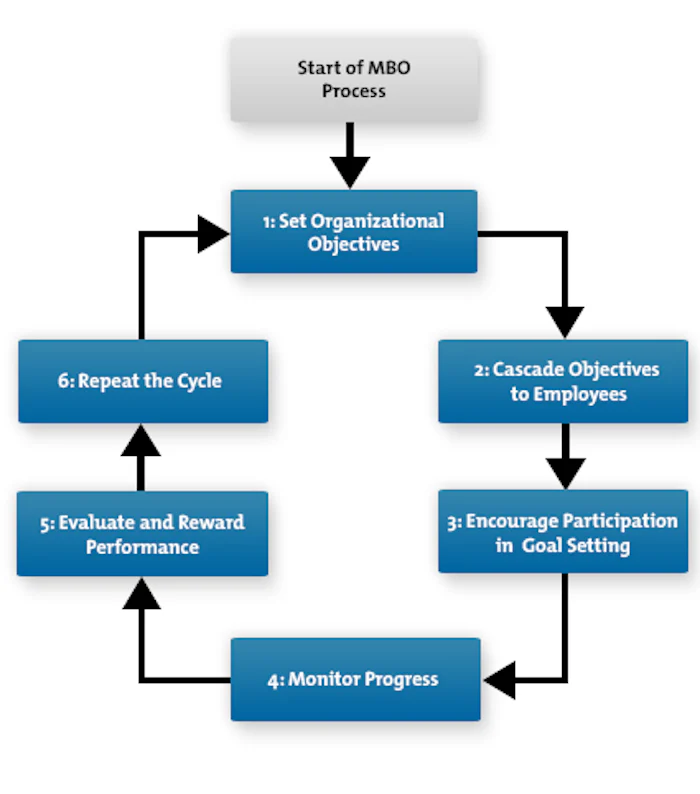
Drucker outlined the six-step process for MBO shown in Figure 1. Each stage has challenges that you must address for the whole system to work effectively.
Figure 1: The Six-Step MBO Process
Adapted from The Practice of Management, by Peter F. Drucker. © 1954 by Peter F. Drucker. Copyright renewed © 1982 by Peter F. Drucker. Preface © 1986 by Peter F. Drucker. Used by permission of HarperCollins Publishers.
To use MBO with your team, follow the steps below.
Step 1: Set or Review Organizational Objectives
MBO starts with clearly defined strategic organizational objectives, expressed in concise, easily-understood Mission and Vision Statements.
These statements should contain specific goals. Vague goals such as "improving customer satisfaction" may mean little to team members; and they're also difficult to measure. A better objective is to "reduce customer complaints by 90 percent." This objective is exciting because it's challenging, and it's much easier to measure.
Remember, if your organization isn't clear about where it's going, no one working there will be either.
Step 2: Cascade Objectives Down to Employees
To support the mission, the organization needs to set clear goals and objectives for every business unit, department, team, and employee. (These goals are cascaded down from level to level.)
To make MBO goal and objective-setting more effective, use the SMART acronym to set attainable, clear goals. SMART goals are:
- Specific.
- Measurable.
- Agreed.
- Realistic.
- Time related.
(Notice the "A" in SMART stands for "Agreed" in a team context. When used on a personal basis, "Achievable" is sometimes better, but, with MBO, agreement about goals is fundamentally important.)
It's not enough to set the goals and objectives at the top and hand them down. They must flow down through various stages of agreement. This is because, in general, the goals that people meet are ones that they agree upon. (VMOST Analysis can help you ensure that goals and tasks align with your organization's vision.)
Establish clear targets and performance standards for each objective, which you can use to monitor progress throughout the organization. These are also important for communicating results and for evaluating the suitability of the goals that you've set.
Step 3: Encourage Participation in Goal Setting
Team members need to understand how their personal goals and values fit with the organization's objectives. This will be most successful when you share and discuss goals and objectives at each level, so that everyone understands why things are being done.
Start by meeting with your team members one on one. Discuss their personal and career goals, and help them identify their top five values. Use this discussion to guide them in writing a personal mission statement that concisely defines what they want to accomplish. (If your organization is recruiting effectively, then new recruits' values should be closely aligned with those of the organization.)
Next, look at your organization's objectives. How do your team members' personal values and career goals align with the organization's goals?
If this isn't obvious at first, use techniques such as Drill Down or 5 Whys to get to the root of their personal goals. Once you identify what they care about most, explain how employees' personal goals align with your organization's objectives.
Where you can, allow team members to set their own goals to help the organization achieve its objectives. This autonomy will increase ownership and motivation for the objectives.
Rather than blindly following orders, managers, supervisors, and employees in an MBO system know what they need to do and why they need to do it. By pushing decision making and responsibility down through the organization, people can solve problems intelligently and independently, and this increases motivation and effectiveness.
Every person in the organization participates in setting his or her own goals. These contribute to the overall objectives of the team, which contribute to the objectives of the department, which contribute to the objectives of the business unit, which contribute to the organization's objectives.
Tip:
Keep in mind that there is a lot more to motivating people than just using MBO. Take our How Good Are Your Motivation Skills? self-test to find out which aspects of team motivation you can improve.
Step 4: Monitor Progress
To be effective, you must monitor your team members' progress toward achieving goals. The monitoring system you create needs to be timely, so that you can deal with issues before they threaten the achievement of important goals. With the cascade effect, no goal is set in isolation; and missing targets in one area will affect targets everywhere.
On the other hand, it's essential to ensure that poorly-designed goals are not driving perverse behavior. For instance, a call center goal of finishing all calls within seven minutes might encourage team members to handle each call briskly, and not spend unnecessary time chatting.
However, it might be that customers' calls become more complex, but call center operators terminate their calls after 6 minutes 59 seconds to meet their target. Clearly, this will upset customers, who then have to call back. In this situation, the monitoring process should pick up the shift in the goal environment and change the goal.
Set up a specific plan for monitoring goal performance (once a year, combined with a performance review, is not sufficient!) Plan on meeting once every three months – or as often as appropriate – to discuss performance and chart progress. Write a performance agreement for your team members, and make sure that they understand how you will measure their performance.
Keep in mind that MBO is essentially a management process. Don't use it as a substitute for good leadership: the two should work together!
Step 5: Evaluate and Reward Performance
MBO is designed to improve performance at all levels of the organization. To ensure that this happens, you must have a comprehensive evaluation system in place.
Give constructive, thorough feedback to all employees on their goals and on the organization's goals. Remember the participative principle: when you present organization-wide results, you have another opportunity to link specific individual and group achievements to corporate performance. Ultimately, this is what MBO is all about and it explains how, when done right, it can spur organization-wide performance and productivity. Just make sure that any performance monitoring system accounts for environmental and market conditions.
Once your team members have met their goals, you can reward them in several ways. A simple "thank you" for a job done well will go a long way, you can highlight their achievements to the group, and you can compensate them strategically for the work that they do.
When you reward goal achievers, you send a clear message to everyone that goal attainment is valued and that the MBO process is not just an exercise, but also an essential aspect of performance appraisal.
Step 6: Repeat the Cycle
Once you have been through the first five steps, the cycle will begin again with another review of your organization's objectives and goals.
When reviewing these objectives and goals and creating new ones, ask for feedback from employees on what went well and what could be improved, consider environmental factors, and take into account your team's past performance.
Key Points
MBO is a powerful tool for aligning employees' actions with an organization's goals.
By empowering people to take responsibility for their performance, and by encouraging them to see how their achievements affect the organization as a whole, you can increase their motivation, dedication, and loyalty.
When you bring that full circle and link performance to evaluation and appraisal, you have a strong system that supports and values employees, and encourages great performance.
References[1] Drucker, P.F. (1954). 'The Practice of Management,' New York: HarperCollins.