Access the essential membership for Modern Managers
The various challenges and demands of change management dictate that an effective change leader will require a broad set of professional and personal skills. This article summarizes these characteristics, as outlined by a number of key thinkers on the subject of change: John Kotter, [1] Rosabeth Moss Kanter, [2] and David Buchanan & David Boddy. [3]
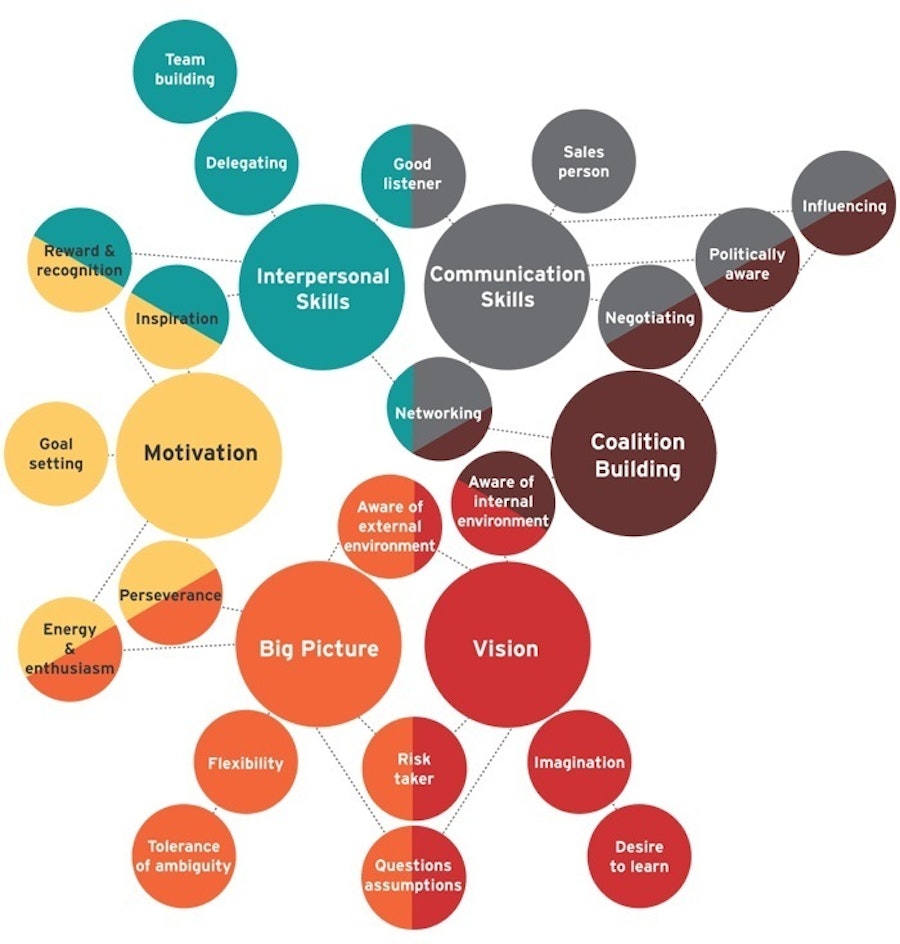
The above graphic shows the full set of characteristics and skills required of a strong change leader. While they are all inter-related to a degree, some relationships are stronger than others. They can loosely be grouped under the following six headings:
- Vision
- Coalition Building
- Communication Skills
- Interpersonal Skills
- Motivation
- Big Picture
Vision
One of the fundamental requirements for a change leader is the ability to see a future which is better than the current state, and to identify and explain exactly how it will be different. Whatever changes are eventually required, the change leader will need the imagination to create that ideal vision.
They will also need to see beyond the established traditions and practices of the organization by constantly questioning assumptions about business practices and being open to different solutions and innovations. This behavior will also be essential later, when negative assumptions about the change or established practices may have to be addressed and broken down, to overcome resistance. Taking risks on new ideas is an inevitable aspect of leading change, often requiring a major psychological shift for people to let go of things they assume are necessary.
Change leaders must also be highly aware of the external environment and have a real desire to learn, proactively keeping up with industry developments, new ideas, practices and technology that may act as drivers for change. More importantly, it will drive them to continually improve as a change leader and act as a role model within their organization.
Coalition Building
Change experts Kotter, Moss Kanter, Buchanan and Boddy all identify coalition building as vital to success. A change leader has to bring together a strong coalition to head the change exercise, in order to lead the effort decisively and effectively. To put together a team with the right mix of skills, experience, personalities, contacts and influence, a change leader will need to be highly aware of the internal environment as well as being acutely politically aware. Once the coalition is in place, these skills will also be necessary to balance any conflicting goals, personal agendas or perceptions within the team.
These particular qualities will not only apply to building and managing the guiding coalition, but also to keeping abreast of people’s reactions throughout the change process. To this end, it may be wise to set up ‘listening posts’ across the organization, with individuals or offices gathering relevant information, like key changes to personnel, employee suggestions, customer complaints or individual perceptions of the change. This will give the change leader the opportunity to quickly address problems or resistance as they arise, and to take advantage of any new ides which could be beneficial.
Communication Skills
Strong communication skills are essential to every aspect and stage of a change process. Initially, change leaders have to be excellent salespeople, to describe and sell their vision of the future and the need for change to everyone from senior management to customer-facing employees.
They will need strong networking and influencing skills, to identify and get buy-in from key stakeholders, both for the guiding coalition and across the organization. This may also have to extend outside of the organization, depending on the specific circumstances of the change exercise.
Once the change leader has buy-in from senior management, one of the most vital communication efforts will be to demonstrate that commitment across the organization. Regular communications and updates about the change will not only show the wholehearted commitment of management, they will also be useful in overcoming resistance by helping everyone to feel involved and well-informed.
The change leader will also need to be adept at negotiating with key players, like departmental heads or budget holders, for resources, for changes in procedures, and to resolve conflict. Buchanan & Boddy specifically identify the need for ‘backstage activity’: “the politicking, the wheeler-dealing, the fixing and negotiating, the coalition building and the trade-offs” which cannot be openly discussed in the organization without damaging the credibility and legitimacy of the change exercise.
Interpersonal Skills
Closely linked to communication skills, an effective change leader also needs a range of interpersonal skills to be an effective team builder, bringing people together and inspiring them to work towards the vision.
At the same time, the leader must be a good listener, inviting and accepting feedback from their team and knowing when to delegate specific decisions, tasks and responsibilities to managers and specialists. This will often mean defining what needs to be achieved by a person, team or department and allowing them to decide exactly how they go about delivering that aim.
Motivation
The enthusiasm generated at the beginning of a change exercise can quickly fade, so the ability to motivate others throughout the process is essential. This is particularly important where the pace of change is slower than expected or results are not as strong as anticipated. In these circumstances, a change leader will have to call on their own reserves of energy and enthusiasm, both to keep their own spirits up and to infect others with their commitment and drive.
Good goal setting should be an intrinsic part of motivation. Goals must be clearly defined and challenging, but achievable. Overambitious or unrealistic goals are counterproductive and likely to demotivate people who feel too much is expected of them. Setting early goals that should be easily and swiftly achieved provides quick wins, which can be hugely valuable in raising morale, securing commitment and overcoming skepticism. However, it is also important to plan medium and long-term goals too, providing both a structure and targets to aim for.
Equally important, when people achieve their goals, is that they receive reward and recognition for doing so. Even if budgets are tight, it’s important to celebrate successes. Simple things like a personal thank you from the chief executive or recognition on a company intranet can go a long way to making people feel appreciated and that their work is valued.
Big Picture
A large part of overcoming difficulties will be the ability for the change leader to step back and see the big picture. This will not only help to keep their personal motivation up during stressful periods, but will also help to keep an eye on the ultimate priorities and objectives of the change exercise without becoming sidetracked by minutiae.
The perseverance to keep pushing forward will be necessary here, as well as the flexibility to respond to unforeseen obstacles, which may require adjustments to specific goals or management style, for example. A tolerance of ambiguity is also essential, allowing the change leader to function comfortably, patiently and effectively in uncertain environments.
Conclusion
While the specific abilities necessary within an organization or change exercise will vary depending on circumstances, this set of skills should give a change leader a strong foundation to build on. Use the attached exercise to gage your own aptitude levels with the essential skills of a change leader, and to identify areas which you may want to concentrate on developing.
References[1] A professor at Harvard Business School, founder of change consultancy Kotter International and creator of the highly-regarded ‘Eight-Step Process for Leading Change’, John Kotter's key publications include Leading Change (1996), The Heart of Change (2002) and Our Iceberg is Melting (2006).
[2] Former editor of the Harvard Business Review and a professor at Harvard Business School, Rosabeth Moss Kanter’s long list of publications includes the 1992 book The Challenge of Organizational Change: How Companies Experience It and Leaders Guide It.
[3] David Buchanan is Professor of Organizational Behavior at Cranfield University School of Management. David Boddy is an honorary research fellow at the University of Glasgow’s Adam Smith Business School. Together, they wrote the 1992 book The Expertise of the Change Agent: Public Performance and Backstage Activity.