


Access the essential membership for Modern Managers
Transcript
Hello. I'm Cathy Faulkner.
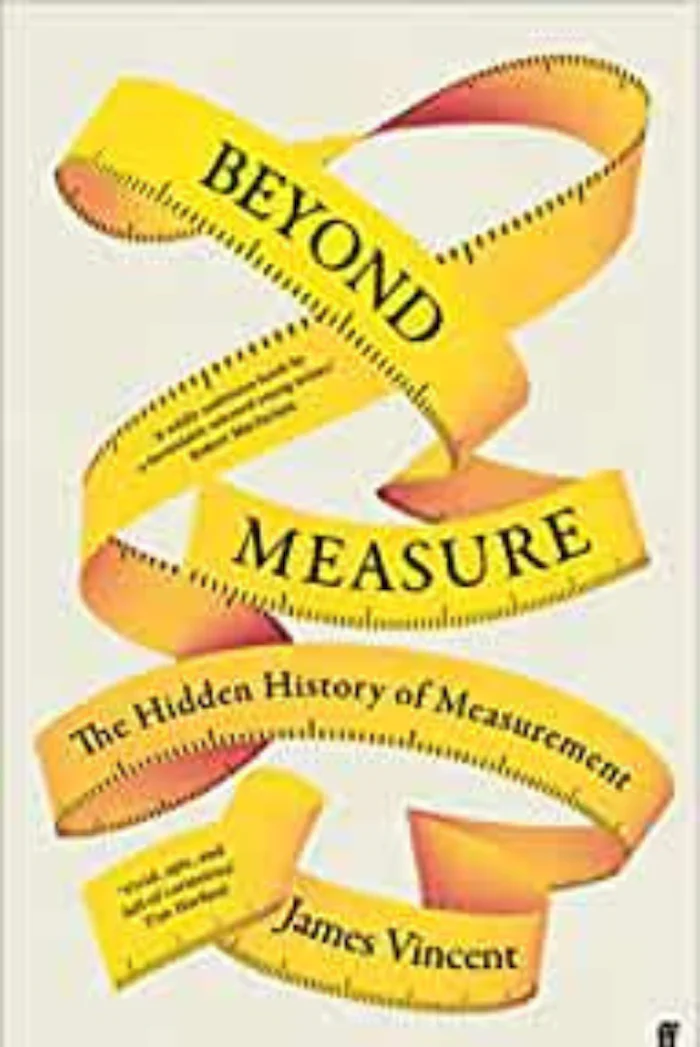
In today's podcast, lasting around 15 minutes, we're looking at "Beyond Measure: The Hidden History of Measurement," by James Vincent.
It's hard to think of a world without measurement. We plan our days successfully because we can measure time accurately. We quantify everything around us by its length, volume and weight. We know what's expected of us in our working lives because of our accurately calculated goals, and we make decisions on our health, fitness and well-being based on the wealth of data that we can measure daily.
But how has measurement come to be such a vital part of how we see the world? When did we start doing it, and why? And what are the implications for us in a digital world, in which we can seemingly measure everything?
These are just a few of the questions that James Vincent sets out to answer in "Beyond Measure."
It's possible to see the history of measurement as part of the rise of human technology. There's certainly a huge gulf between a few tally marks carved into a bone, and a modern supercomputer that can perform millions of calculations every second.
But while our ability to quantify things has grown throughout human history, it only answers the question "how do we measure?" It doesn't address the question "why do we measure?" And that question has a remarkable history of its own. It's a question tied intimately to what it means to us to be human.
Most people will get something from this book. It contains plenty of historical facts, some of them great fun. But it also tells a good story. And there's plenty of reflection on the uses of measurement, and how it's changed the way people think about themselves and the world over time.
At the end of the book, the author's thoughts turn to the present and the future, too. This'll be of interest if you're concerned about how much data analysis rules our lives. But we'll come on to that later.
James Vincent is a journalist and writer. He has written for the London Review of Books, the Financial Times, the Independent, Wired, and the New Statesman. He's currently a senior reporter for online technology magazine The Verge.
"Beyond Measure" is Vincent's first book. His fascination with measurement began on an assignment to cover the redefinition of the kilogram, as recently as 2018. It certainly seems to have captured his imagination. His enthusiasm for the subject is obvious, and the scope of his book enormous.
So keep listening to hear more about variations in the humble collop, why one person's bushel is not like another's, and how the West was won by a jointed chain.
"Beyond Measure" is organized chronologically, as you'd expect from a book that declares itself a history. It's 10 chapters take us from human prehistory to the rise of Big Data. Unsurprisingly, it doesn't set out to cover every detail in the history of measurement. That would be a work of many volumes.
Instead, it focuses on key developments in the history of measurement. In particular, it ties advances and issues in measurement with milestones in the history of human thought and experience.
So when did all this start? You've already heard that the earliest measurements were likely tally marks made on animal bones. These bones date from the Upper Paleolithic period, the last part of the Old Stone Age. They're likely 30,000 years old or more.
They seem to have recorded numbers, usually in multiples of five. Most humans have five fingers on each hand, after all. But what these marks recorded is lost. They could have stood for livestock, predators killed, or the passage of days. We don't know.
We do know that humans began to feel the need to record things. And as civilizations developed, those needs became more complex.
Take the nilometers of Ancient Egypt, for example. Nilometers are special chambers that measure the river Nile. Specifically, they measure the depth and extent of the Nile's annual flood.
Life in Ancient Egypt was dependent on the Nile. In years following a deep, widespread flood, farmers could expect a bountiful harvest. But if the flood was shallow, farmland away from the river would be less fertile. Nilometers could predict the difference between plenty and famine.
This measurement was crucial to the economic planning of the Egyptian state. It also had political impact. If people are hungry, unrest is more likely. The pharaohs knew that they needed to store and distribute their food wisely. But they also knew when they might need to have the army on alert.
Perhaps more importantly, the nilometer could give a ruler an idea of where they stood in the favor of the gods. This was vital in a highly religious society like Egypt.
So one of the most striking examples of measurement from the ancient world was also bound up with religion, awareness of status, and the exercise of power. It's a theme Vincent returns to in later contexts.
The range of things that people wanted to measure grew as civilizations developed. The need to categorize and control things became more pressing as life became more complex.
So did the need for standardization. Measurements in relatively unsophisticated societies were rough and elastic. Medieval Irish farmers had a measurement called a collop, a unit of land area required to graze one cow. Inevitably, the size of a collop varied enormously depending on the quality of the pasture. A collop in a rich, green river valley would be much smaller than its equivalent on an upland moor.
The collop answered the specific needs of a relatively simple agricultural community. But what happened when different communities met?
When it came to trading goods, people began to need standardized forms of measurement. And those who could define and implement successful standards became powerful.
You've already heard that developments in measurement took place alongside developments in other fields, particularly technology.
For example, the mechanical clock was invented in medieval Europe. It revolutionized the way people understood their world. Time had been thought of as a continuous flow, bounded only by night and day. Now it became a sequence of discrete, measurable periods. People could manage the length of the working day, and organize themselves accordingly. Merchants could arrange meetings, and hold markets at agreed times. Astronomers could accurately measure the passage of stars across the night sky.
Medieval thinkers were keen on metaphor. The clock became a symbol for the entire universe: orderly, mechanical, and the clear product of a divine will. But as human understanding progressed, ideas would arise to challenge this worldview.
When Galileo made his observations and measurements of the night sky in the late 16th century, he paved the way for Johannes Kepler's model of a universe with the Sun at its center. The Sun, not the Earth. This was truly radical thinking.
It was the beginning of the period historians call the Enlightenment. Science was starting to challenge the status of religion as the source of all knowledge. And measurement was at its heart.
Society was ripe for change too. Medieval peasants across Europe had to use unjust measurement systems which favored landowners and merchants. Consider the bushel, a flexible measure of capacity roughly equal to eight gallons. The key word is roughly.
Peasant farmers used their grain for three purposes: to feed their families, pay their feudal dues, and barter for goods at market. What the farmer thought was a bushel of grain might not be what a landlord or a merchant thought it was. The powerful and unscrupulous might have bigger bushels, or insist that they be filled to the brim. They might shake or strike the bushel so that the grain settled.
This meant the peasant would have to hand over more grain for the same money, or to fulfill their dues. In a bad year, this could mean the difference between eating and starving.
So it's no surprise that growing calls for the reform of society stressed the importance of accurate, standard weights and measures. These calls came to a head during the French Revolution.
By 1789, standards of measurement in France had gone unreformed for many centuries. Some sources estimate that there were more than 1,000 distinct measurements of everyday quantities, with further variations at a local level.
When the revolution swept away the French monarchy, it also set about dismantling archaic measurements. The results were the standard kilogram and the standard meter.
For 200 years, these were physical objects, kept securely in the Louvre. Accuracy was based on exacting measurements drawn from nature. And they were, literally, the law. All commercial transactions involving measurements had to use the meter and the kilogram. They embodied a principle of fairness in a way that was quite new in human history.
So far, so good for standardized measurement. It's been both a companion to the progress of civilization, and often a driver of it. But there's a darker side.
Edmund Gunter was an English clergyman and mathematician. In 1620, he invented a device that became known as Gunter's Chain. It changed the face of land surveying. Gunter's Chain was a series of connected metal rods which could be opened out to a length of 66 feet, or 22 yards. It allowed surveyors to measure and parcel out large areas of land, accurately and relatively quickly.
This was certainly a technological advance. Many of its applications were valuable. But the way it was used could also cause untold misery and suffering. Oliver Cromwell used it to parcel out land seized from the peasantry in his brutal war in Ireland. The British used it to impose their standards of land ownership in India. But perhaps the most comprehensive and damaging use of Gunter's Chain was in America.
The ownership of land was a key issue for early European settlers, and they brought with them the ways they understood. Their Bible contained stern commands about the importance of boundary markers. The surveys of the Domesday Book had stamped Norman authority on Saxon England. Everything was owned, and that ownership had to be clear.
The native peoples of America lived in a huge range of cultures, from hunter-gatherers to highly sophisticated farmers. Few believed that the land could be owned. It was a common resource.
The colonists thought otherwise. They divided up North America with mathematical precision. They decided who owned what, and legalized that ownership in one-sided treaties. It turned out that the native people owned very little. Nowadays it's commonplace to describe their treatment as a form of genocide. And Gunter's Chain was complicit in it.
That doesn't mean that measurement is necessarily evil. But it's rarely a neutral activity. And as measurement has developed, it has become more personal, and sometimes more intrusive.
Take the science of statistics, for example. It dates back to the 18th century, and now it standardizes and dictates many aspects of our lives.
In the 20th century, industrialists used statistics drawn from observation to make processes more efficient. They swept away artisan workshops in favor of production lines. In doing so, they transferred power from skilled workers to a new class: the managers.
And now the digital age seems to quantify everything, bringing efficiency down to a very personal level. The book talks of the "Quantified Self " movement, whose members seek to improve everything they do, by measuring it. They argue that measurement can make us fitter, help us manage our time better, and work more efficiently.
Algorithms offer us consumer choices based on the data they've gleaned about us. Cameras measure our faces and biometric data confirms our identities. In fact, to some extent, we've all become the sum of our measurable data.
It's a liberating vision of the future of humanity – or a very bleak one, depending on your point of view. What does Vincent make of it?
In his Epilogue, he admits to being a keen measurer. He quantifies things, as many of us do. He also has more qualitative measurements of things that are hard to quantify. Happiness, for example. But he warns against prioritizing measurement over the importance of the thing we're measuring. It serves a purpose, but shouldn't become that purpose.
So is "Beyond Measure" a success? We'd say so. It's not an exhaustive academic account of the entire history of measurement, and doesn't pretend to be. But it does emphasize the importance of measurement in the history of human thought and experience.
Is the history it seeks to reveal really "hidden?" Probably not, although the level of research is excellent. The book is full of surprising anecdotes and observations. Even the footnotes are enjoyable, and worth a read. You may have read about nilometers and the standard kilogram before, but you'll still find much here to think about.
"Beyond Measure" is also a very anecdotal and reflective book. It's never a dry catalog of events. Vincent invites the reader to share in human experiences. Measurement can enable and enhance those experiences and our understanding of them. Whether it should dictate them is another matter. It's a tension at the heart of the subject. Maybe it's one that can't be resolved.
As we said at the start, the book explains the "why" of measurement alongside the "how." As such, it's thought-provoking on how human beings think, what matters to them, and how they understand and control their knowledge.
The grievances of the French peasantry in the run-up to the French Revolution were as often about biased standards of measurement as about personal freedom. And the call for standardized weights and measures in England's Magna Carta was reaffirmed 500 years later in the American Declaration of Independence.
These are important documents. Measurement matters. It matters to people, their governments, and now, to global corporations. This book serves its importance well.
"Beyond Measure: The Hidden History of Measurement," by James Vincent, is published by Faber and Faber.
That's the end of this episode of Book Insights. Thanks for listening.


